Knowing what to do is not the same as doing it when it’s messy.
Most capable people can recognise a smart move once they see it.
That’s not the hard part.
The hard part is what happens under pressure — when the path is unclear, the stakes are high, and your brain reaches for what feels safe.
That’s what this page is here to show you.
You don’t need more theory to understand this.
You need language for why smart people still drift — and why getting better takes more than knowing the right answer.
This is also why many strong specialists hit what we called the Specialist Ceiling—not because they lack ability, but because the game changes under pressure.
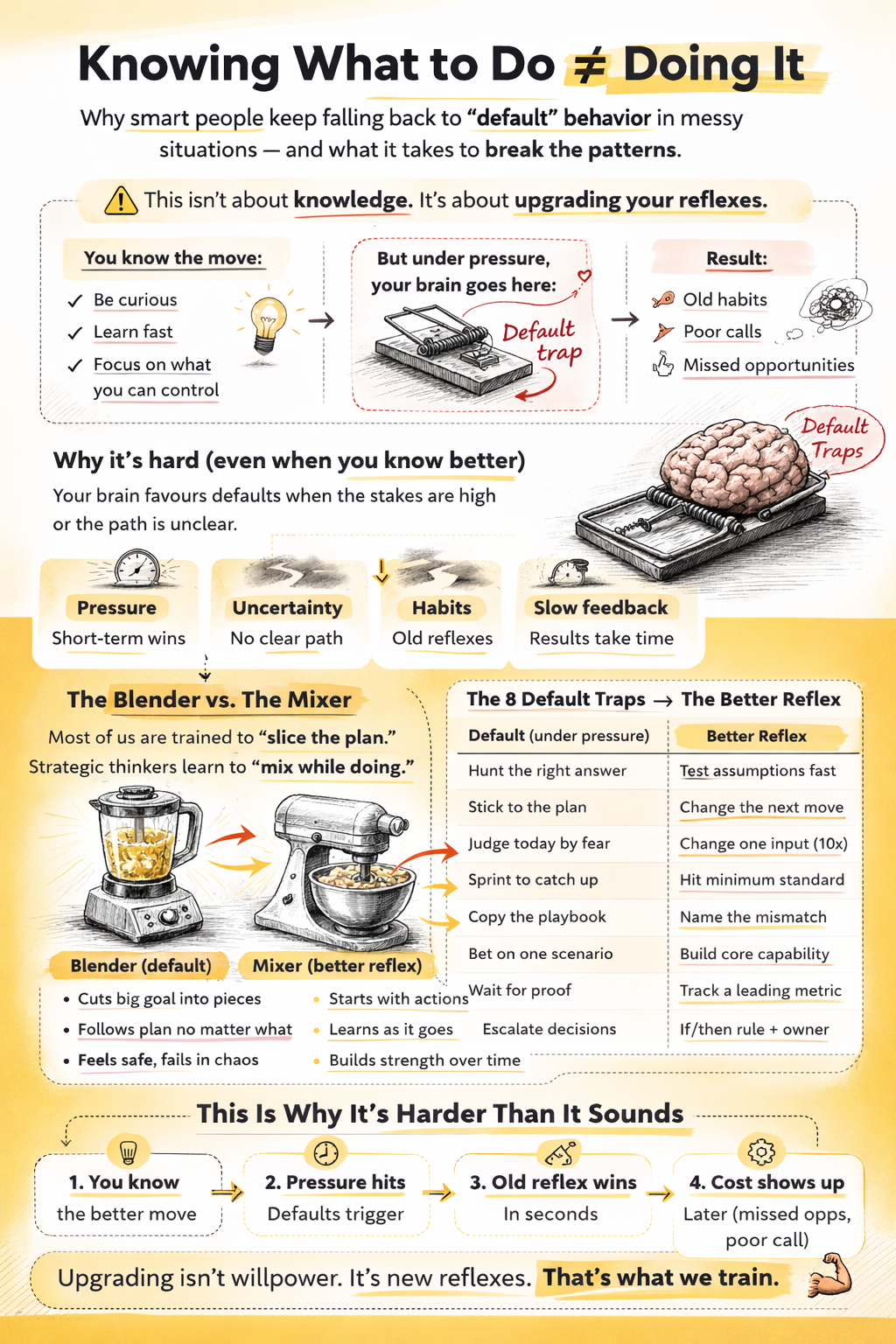
The 8 Defaults (and the Better Reflex)
This first table is your map.
It names the 8 defaults that tend to take over in messy terrain — and the better reflex that beats each one.
If one of these feels uncomfortably familiar, that’s the point.
These are normal human defaults.
The advantage comes from noticing them sooner and switching faster.
So that’s the map of the left side and the right side.
If you’ve ever been told you’re “not strategic enough,” this is usually what sits underneath it.
It’s not a lack of thinking—it’s these defaults under pressure that create the Specialist Ceiling.
So a fair question comes next:
What does the better reflex actually look like in real life?
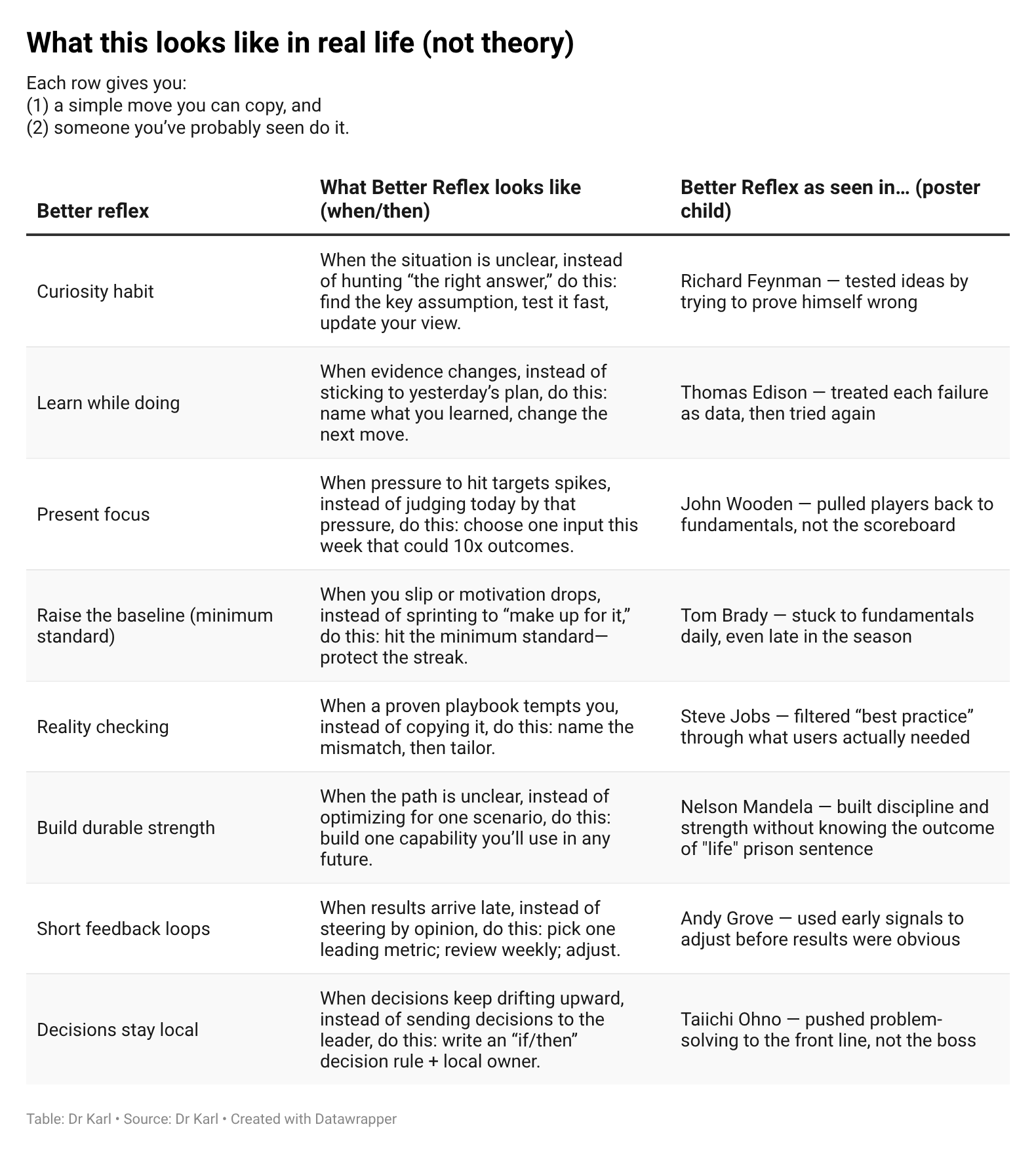
What the Better Reflex looks like (as behaviour)
It’s easy to agree with the better reflex in theory.
It’s harder to picture it as behavior.
So here are two ways to make it concrete:
a simple when/then move you can copy, and
a “poster child” familiar person you may already recognise as living that reflex.
That makes the better reflex easier to picture.
Now let’s make it easier to feel.
Now let’s make it real in ordinary life
Here are two quick walkthroughs — one personal, one team — showing what these reflexes look like in ordinary life.
These examples use a 4-reflex starter kit. The tables above show the full set of 8 defaults and better reflexes.
Example 1 — Personal: Health
Shock line: Health plans don’t fail because you lack discipline. They fail because life is messy.
The trap: You use an exploit tool (a fixed plan) in exploration terrain (a week that won’t hold still). The plan breaks, guilt spikes, you restart with a stricter plan—and the trap tightens.
The Wayfinding moves:
Curiosity habit: ask “What might I be wrong about?”
Raise the Floor: pick the baseline you keep on your worst week.
Short Feedback Loops: track one actionable signal weekly.
Spread the Reflex: pre-decide the “if-then” that saves you when life hits.
Before --> After
Before: 'perfect week" plan --> missed day --> shame spiral
Start here: Ask “What might I be wrong about?” then pick a non-negotiable floor (20 mins walk), one signal (sleep hours), one reflex ("If I miss a workout, I still do the floor").
Example 2 — Team: Growth
Shock line: Execution didn’t fail. The map did.
The trap: Leadership creates a plan, teams “align,” reality shifts, and suddenly:
teams keep executing yesterday’s assumptions (plan-as-truth), and
decisions escalate to the CEO (hero bottleneck), because nobody has a shared way to adapt.
The Wayfinding moves:
Curiosity habit: ask “What might I be wrong about?”
Raise the Floor: weekly behaviors that happen no matter what.
Short Feedback Loops: a short cadence for signal → update → course-correct.
Spread the Reflex: decision rights closer to reality + shared pattern library.
Before → After:
Before: quarterly plan → status meetings → escalation + blame
Start here: A 30–45 minute weekly “course correction” where teams answer: 1) What might we be wrong about? 2) What did reality say? 3) What assumption changed? 4) What are we changing this week?
If you’re thinking, “I get it… but why do I still drift to the default?”
That question is the whole game.
And this is where the gap really shows up — the difference between knowing and doing under pressure is exactly what creates the Specialist Ceiling.
Why you still drift (even when you know better)
Knowing the better reflex isn’t the hard part.
The hard part is that pressure changes the rules.
This isn’t a discipline problem.
It’s what pressure does to humans.
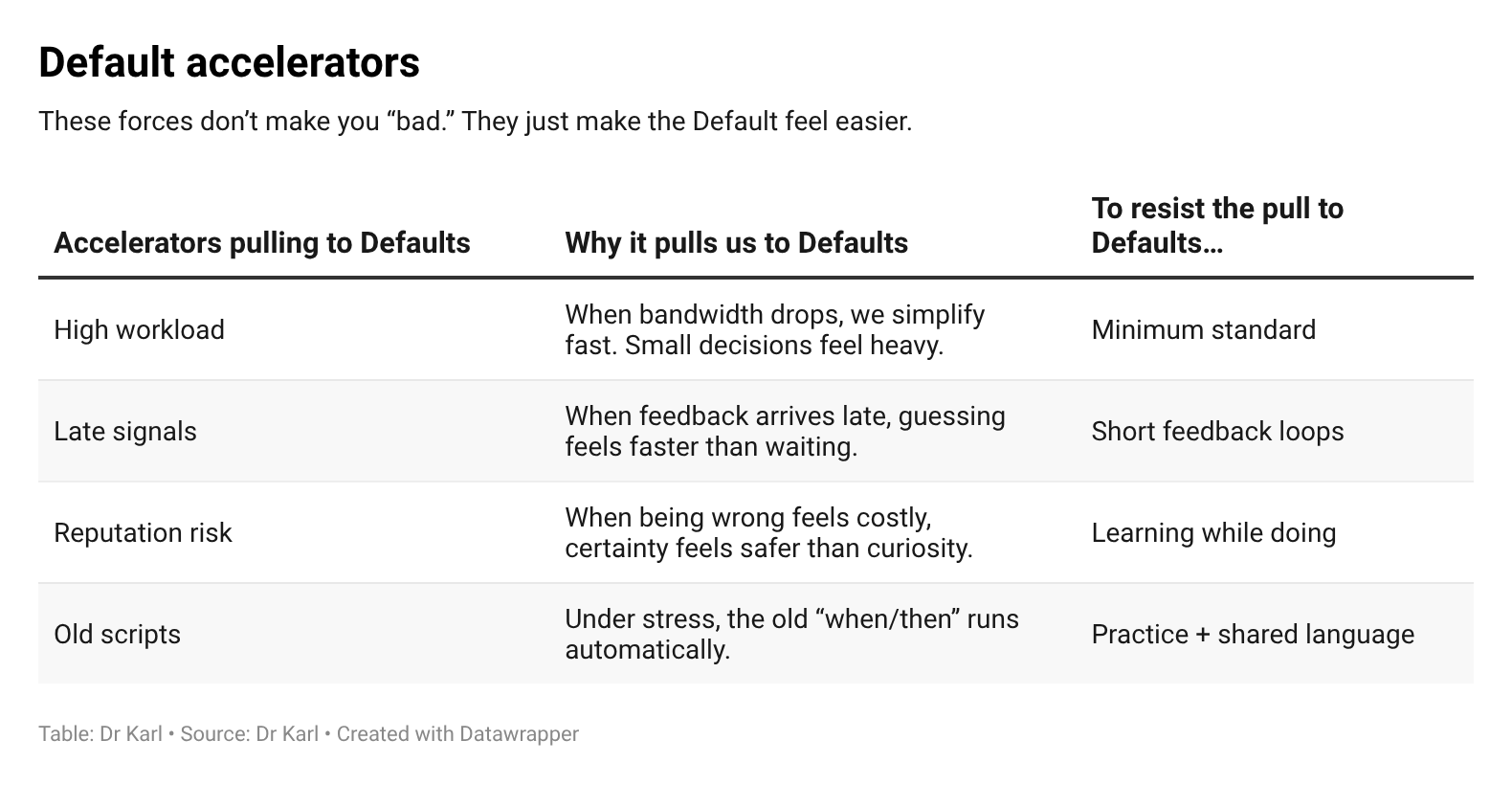
The table below names the forces that make the default feel reasonable in the moment — and what each one points to.
So even when you know the better move, the default can still feel easier.
That helps explain the problem.
But there’s another layer too:
many of us were trained in a way that quietly reinforces the wrong instinct.
The wrong training feels smart at first
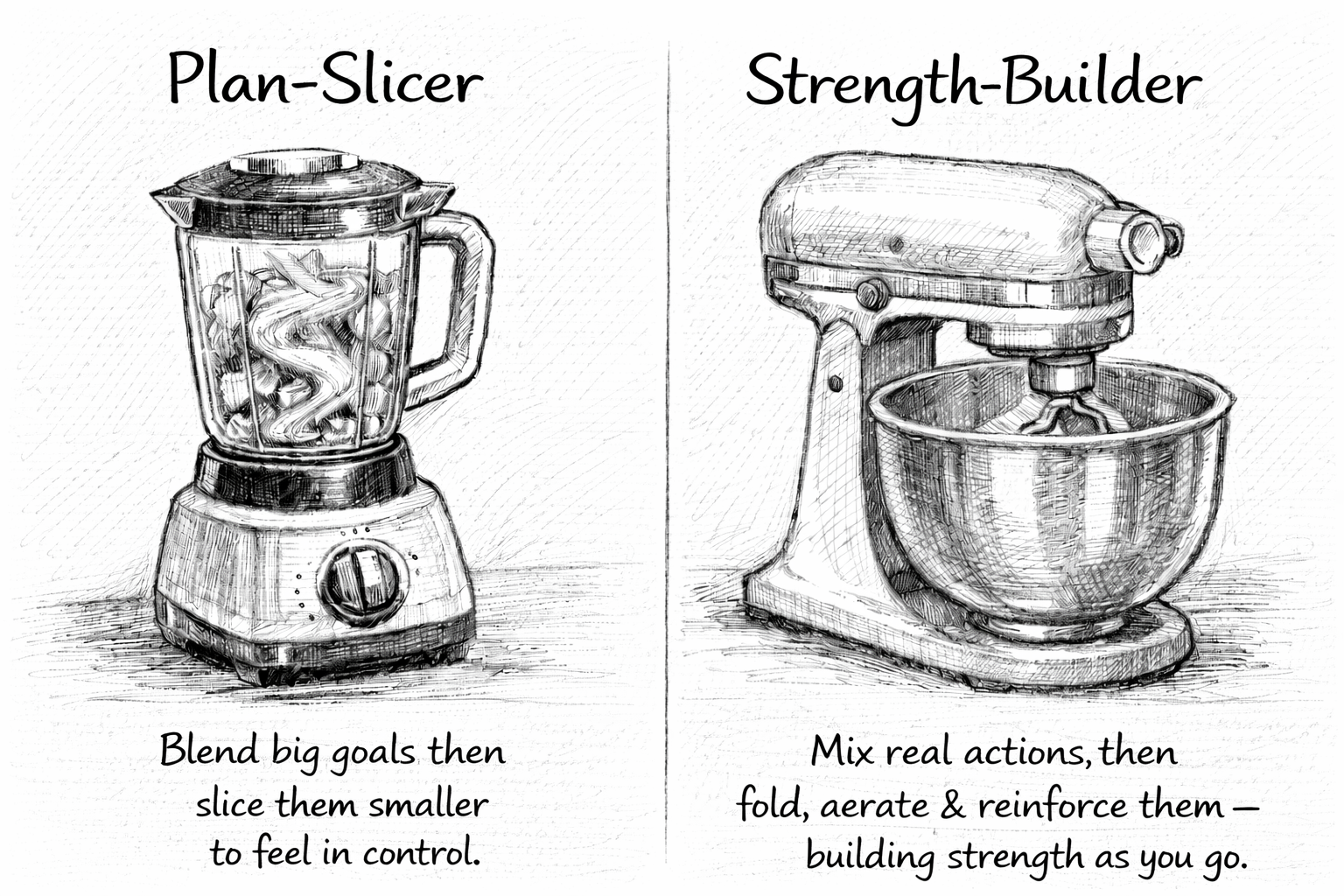
When the future won’t hold steady, most people try to regain control by slicing the plan into smaller and smaller chunks.
That feels smart.
It feels disciplined.
It feels like progress.
But in messy terrain, that move can quietly make things worse.
From Future-Back Handoff Planning to Stronger-Forward Decisions
That’s the difference between plan-slicer thinking and strength-builder thinking.
One tries to force certainty by breaking the path into smaller pieces.
The other builds strength by acting early, learning fast, and reinforcing what holds.
That doesn’t mean the default is stupid.
Far from it.
Most functional roles accidentally train us into blender thinking:
Break the goal into sub-goals.
Break those into milestones.
Break those into tasks.
Then execute harder.
That works when the terrain is stable.
But when it’s messy, blender thinking does something sneaky: it turns uncertainty into smaller, more confident steps — in the wrong direction.
Mixer thinking is different.
It doesn’t slice uncertainty into tiny certainties.
It starts with real action, folds in feedback, and builds structure as it goes.
That’s why being strategic when messy is not just a thinking upgrade.
It’s a behavioral retraining.
That doesn’t mean the default is stupid.
Far from it.
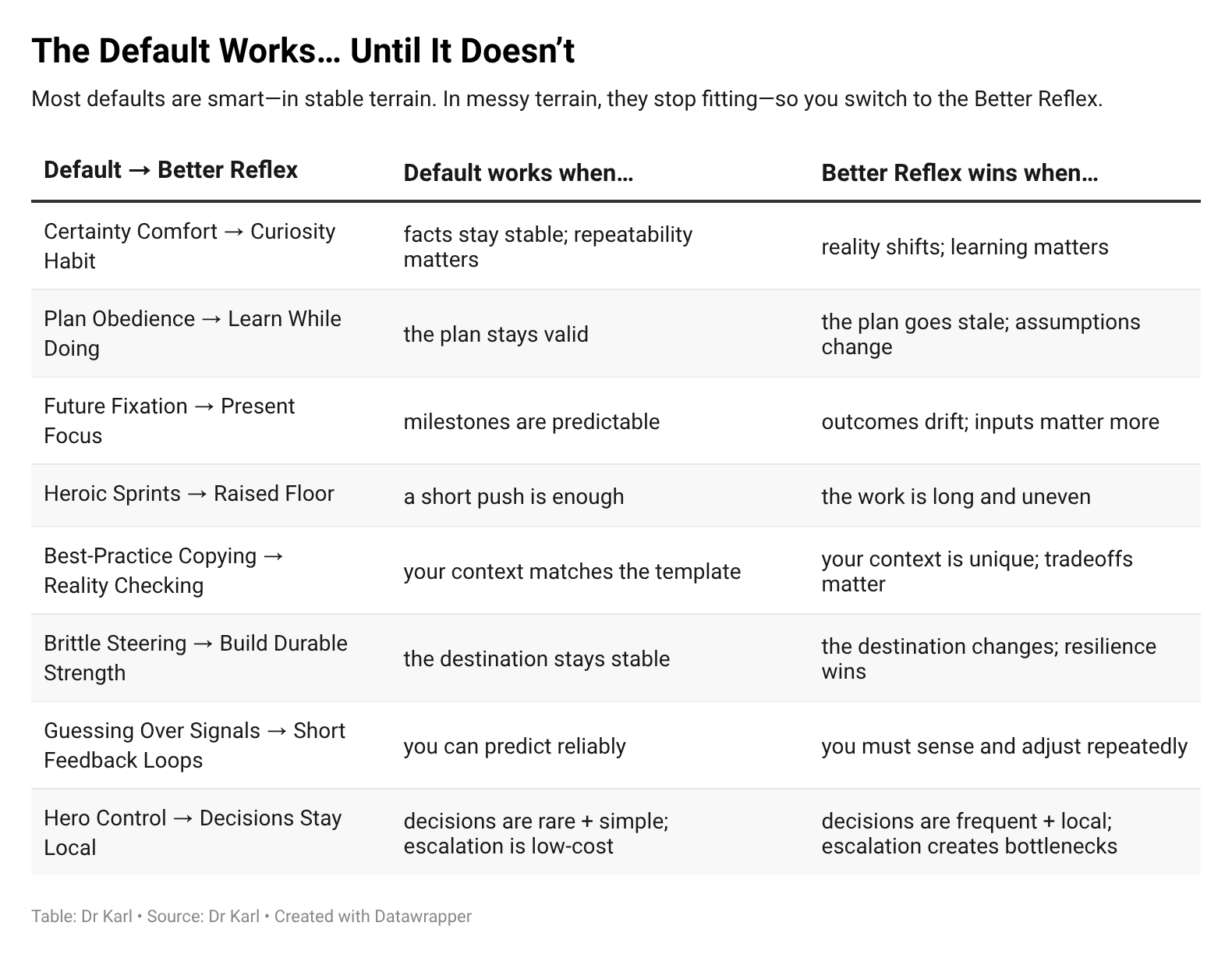
The Default Works… Until It Doesn’t
Most defaults are actually smart—in stable terrain.
In messy terrain, they stop fitting—so you switch to the Better Reflex.
This is what makes the whole thing tricky:
the default often works just well enough to feel trustworthy… right up until it doesn’t.
Quick translation (plain English)
If you want the shortest possible version, it’s this:
Certainty Comfort → Curiosity Habit
Default: Seek the right answer; avoid not-knowing.
Better: Ask what we might be wrong about.
Plan Obedience → Learn While Doing
Default: Follow the plan; treat change as risk.
Better: Act, learn, update—out loud and fast.
Future Fixation → Present Focus
Default: Judge today by a future picture.
Better: See today clearly; improve today’s inputs.
Heroic Sprints → Raised Floor
Default: Sprint harder; rely on bursts of effort.
Better: Keep a minimum standard, even on bad weeks.
Best-Practice Copying → Reality Checking
Default: Copy proven playbooks; assume fit.
Better: Name tradeoffs; choose what fits here.
Brittle Steering → Build Durable Strength
Default: Optimize one path; ignore other futures.
Better: Build capability that transfers across futures.