Why you can trust this isn’t fluffy

I’ve seen “being strategic” from 9 different angles.
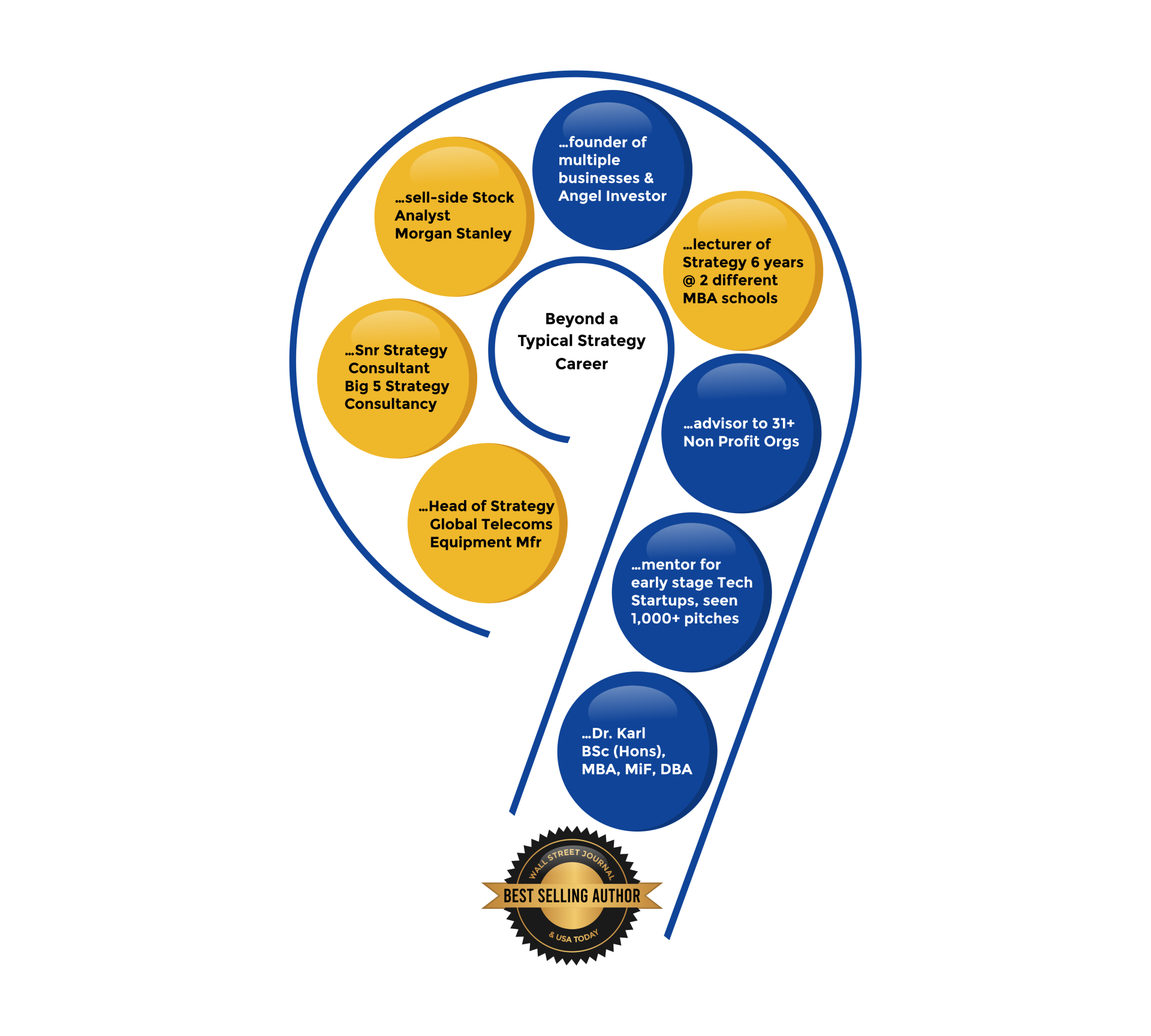
My ‘9 lenses’ map:
yellow = where I went deep; blue = where I went wide.
It’s why this course is practical, not theoretical.
If you’ve been told “be more strategic,” it’s fair to ask: “Okay… but what does that actually mean in real life?”
I built this because I’ve lived that question in roles where being strategic was the job (deep)—and in roles where it had to work in the real world (wide).
Yellow = Where I went deep

  • Head of Strategy (global telecom equipment manufacturer)— I learned that forecasting breaks in uncertain terrain. Better loops beat better plans.


  • Senior Strategy Consultant (top global strategy firm)— Big companies still try to plan uncertainty away. I learnt it doesn’t work.


  • Morgan Stanley sell-side analyst— Learned that don't really want a "plan". They want progress that holds up.


  • Strategy lecturer (6 years, Silicon Valley MBAs)— Learnt that smart people over-trust templates. Being strategic is a practice, not a worksheet.
Blue = Where I went wide

Founder + angel investor
—  Learnt that in uncertainty, fluency, beats perfectly planning.

Advisor to 31+ nonprofit CEOs (and boards)
— Learnt that it works even when the terrain is messier and the stakes feel heavier.

Reviewed 1,000+ startup pitch decks + coached founders
— Learnt that winners aren’t better at templates. They're better at picks and tradeoffs.

DBA on collective decision-making under uncertainty
— Turned the craft into something teachable for real people in real rooms.

Best-selling author
- Contributed to a  book, and had fun making ideas usable.
“Not a guru. A practitioner.”

High-Frequency Strategist

Academically grounded for being Strategic When Messy.
A High-Frequency Strategist is someone who can stay effective when clarity is incomplete—by turning messy situations into clear choices, safe action, and fast learning.

This is the capability that supports:

  • Promotion readiness (shifting from “how do I do what I’m assigned?” to “what needs doing, what gets dropped, and why?”) 
  • Decision bottleneck relief (teams stop waiting on one “decision person” because decisions become shared artifacts + shared rules)
  • Senior-leader operating mode (trade-off clarity + learning loops, not heroic firefighting)


Note: this isn’t a “three-month makeover.” It’s a set of foundations and reflexes you begin practicing and strengthening over time.

Also: we won’t be studying these papers together. This isn’t a theory class. The point of sharing this is simply to show that the behaviors you’ll practice are grounded in decades of serious research.

The academic spine (why this is not “just advice”)

The method is built on long-standing research streams that study exactly these thinking patterns—how people decide under uncertainty, how experts act without perfect information, and how teams learn faster.

1) Bounded rationality and satisficing

Herbert A. Simon showed why humans can’t optimize everything: attention, time, and information are limited. Skilled decision-makers succeed by using simple decision procedures (rules, defaults, thresholds) and reserving deep analysis for the decisions that truly matter.

What it supports in practice: policies like “doors vs dust,” and default rules that prevent cognitive over-spend.

2) Maximizing vs satisficing (and the “reopen the file” cost)

Barry Schwartz popularized evidence that “maximizing” (always searching for the best option) can come with a psychological tax—more comparison, more second-guessing, less satisfaction—even when outcomes are good.

What it supports in practice: learning when to optimize vs when to close, so progress can actually land.

3) Choice overload

Sheena Iyengar & Mark Lepper studied how too many options can reduce commitment and satisfaction in many contexts.

What it supports in practice: compressing a messy situation into a small number of decision-ready branches instead of letting the option set explode.

4) Fast & frugal heuristics

Gerd Gigerenzer showed that in uncertainty, well-designed heuristics (simple rules and thresholds) can be highly effective—not sloppy, but “ecologically rational.”

What it supports in practice: binary thresholds, “go/no-go” rules, and simple policies for routine decisions.

5) Heuristics and biases

Amos Tversky & Daniel Kahneman mapped how human judgment can drift in predictable ways when we rely on intuition—especially under uncertainty.

What it supports in practice: making assumptions and trade-offs explicit, using evidence thresholds, and designing stop-rules that prevent confident-but-wrong momentum.

6) Naturalistic decision making (how experts decide fast)

Gary Klein found that experts often don’t compare many options. They recognize patterns, mentally simulate a workable move, then act—updating as reality responds.

What it supports in practice: shifting from “debate forever” to recognize → test → learn, especially in fast-moving environments.

xxx

xxxx

xxxx

xxxx

xxx

xxxx

xxxx

xxxx

xxx

xxxx

xxxx

xxxx

What you walk away with (without overpromising)

This work is academically grounded because it draws directly from the research above—and it helps you start building a repeatable way of thinking and behaving:

  • clearer choices (trade-offs made explicit)
  • faster motion (small reversible tests)
  • better learning (trace → updated rules)
  • less bottlenecking (shared artifacts + shared decision rules)

The specifics of the loop and tools are simple (and covered elsewhere on the site). The confidence comes from this: the method is built on what leading researchers have spent decades studying about decision-making, sensemaking, learning, and teams under uncertainty.

DECISIONS FACING UNCERTAINTY HEAD ON

"Karl checks the boxes in terms of domain expertise, integrity, making himself available and being easy to work with. However, what stands out with Karl is his keen ability to suggest the great angle we haven't thought of or the strategic element we may have overlooked. I always include Karl in our important discussions because I know he will have insights we need to hear."
Technology Startup Founder
"It was great to go through the process of reviewing where we want to go and how we need to grow.

I now feel like we have a more solid roadmap on what our goals are, whom we want to reach, and the things we need to do to get there. We cannot thank Karl enough for helping us to lay out a roadmap for the organization."
Non Profit Org BOARD

"Karl will forever have a halo of gold around his head-- at least in my mind! He was kind, professional, involved, and cared deeply about my success. He's the kind of guy you definitely want on your side.

I feel grateful to have had his guidance-- it was a privilege to me to have his help!"
Market Positioning & Value Proposition

MOVE FORWARD, DECIDE AS A TEAM

Decide, Better, Together

Turn uncertainty into an asset

At 1Unkown, we understand that you want to be a leader who can guide their team or board in making difficult decisions - even when the future feels uncertain. In order to do that, you and your team or board need to embrace uncertainties and create systems that allow flexibility. 

The problem is old models of strategic thinking and team decision making are rooted in the assumption that the future should be known. But you need a way to lead through the unknown. 

We give you the tools to empower your team or board to be part of strategic decisions that will move your organization forward.

EMPOWER YOUR TEAMS

"Karl was able to solve strategic issues I had been grappling with for weeks in a matter of minutes. He is able to clearly articulate a path forward - I could not be more grateful for the time I spent with him. Thank you Karl!"
TECH START UP: A NEW PERSPECTIVE
"The problem statement we were facing in September was how to continue to grow in a healthy, planned, and strategic fashion. To Develop a strategic forward thinking plan for our future.

Karl helped us to look for strategic projects that we could begin today that would remove barriers, improve processes, and shore up our growth. 

Instead of spinning our wheels and planning for a future state five years from now that we cannot predict, Karl taught us to re-align our current steps to help us to arrive at the future state in which we are serving our community in the best way possible."
Non Profit Org CEO
"Working with you on our strategic planning project has been an educational experience. I walked into this process expecting it to be similar to strategic planning I have participated in at other agencies.

 Your approach to strategic planning required us to slow down and think about our agency differently. As a person who tends to think in spread sheet format, this has sometimes been difficult for me. However, your approach has provided us with a vision of a mature agency as well as action steps to start moving us in that direction.  

Your process has allowed everyone to feel heard, and allowed us to combine ideas and thoughts into actionable ideas. I believe your questions and probing have allowed us to look at our agency from different perspectives. This has been enlightening as we are now finding answers to questions we would not have thought to ask, but are finding to be important as we enhance our programing for the future. "
NON PROFIT CFO

Be the first to know!

Thank you!
We are developing new content all the time for you.
one-click unsubscribe
tips, deals and offers
Created with