What works in stable terrain starts to fail in messy terrain
Some roles get harder because the stakes go up.
Others get harder because the terrain itself changes — the path moves, the signals blur, and yesterday’s strengths stop being enough on their own.
This is where strong people can start to feel slower, less certain, or less ready than expected.
Not because they got worse.
Because the conditions changed.
Stable terrain and messy terrain are not the same game
The difficulty is not just that the work is bigger.
It is that the logic of the work changes.
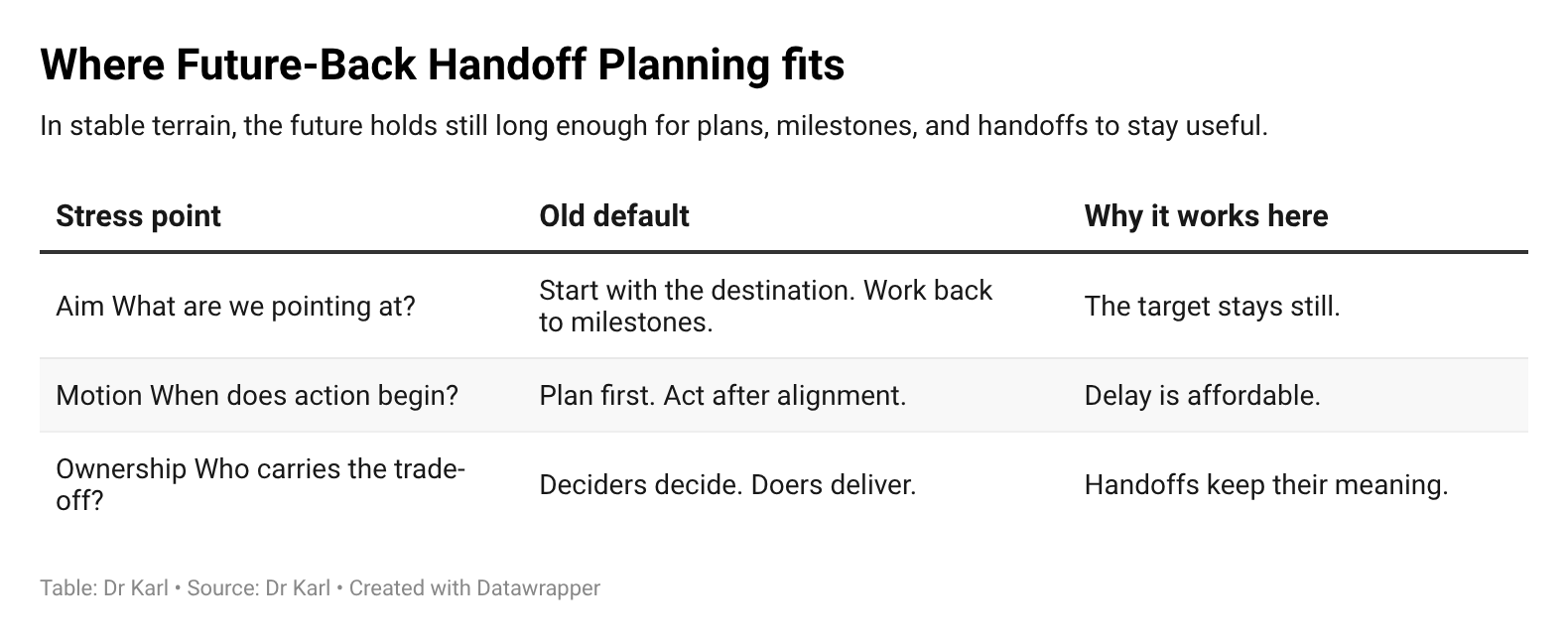
In stable terrain, the path is clearer and the handoff model holds.
In messy terrain, the path moves while you are still on it.
In stable terrain
Clear lanes and path is easier to define.
Cause & Effect are easier to read
Trade-offs, Handoffs & Ownership are more predictable.
Plans survive longer.
Success is easier to measure within a function.
In messy terrain
The path shifts while you are moving
Cause and Effect are harder to read
Trade-offs cut across functions, Ownership gets blurrier.
Plans need live adjustment, Timing & context keep shifting.
Consequences spread further and show up later.
When people use stable-terrain reflexes in messy terrain, the work starts to wobble — even when the people are strong.
Messy is not one thing
People often use the word “messy” as if it just means stressful, political, or unclear.
Messy usually comes from a few repeatable sources.
Once you name which kind(s) you are in, the situation becomes easier to read.
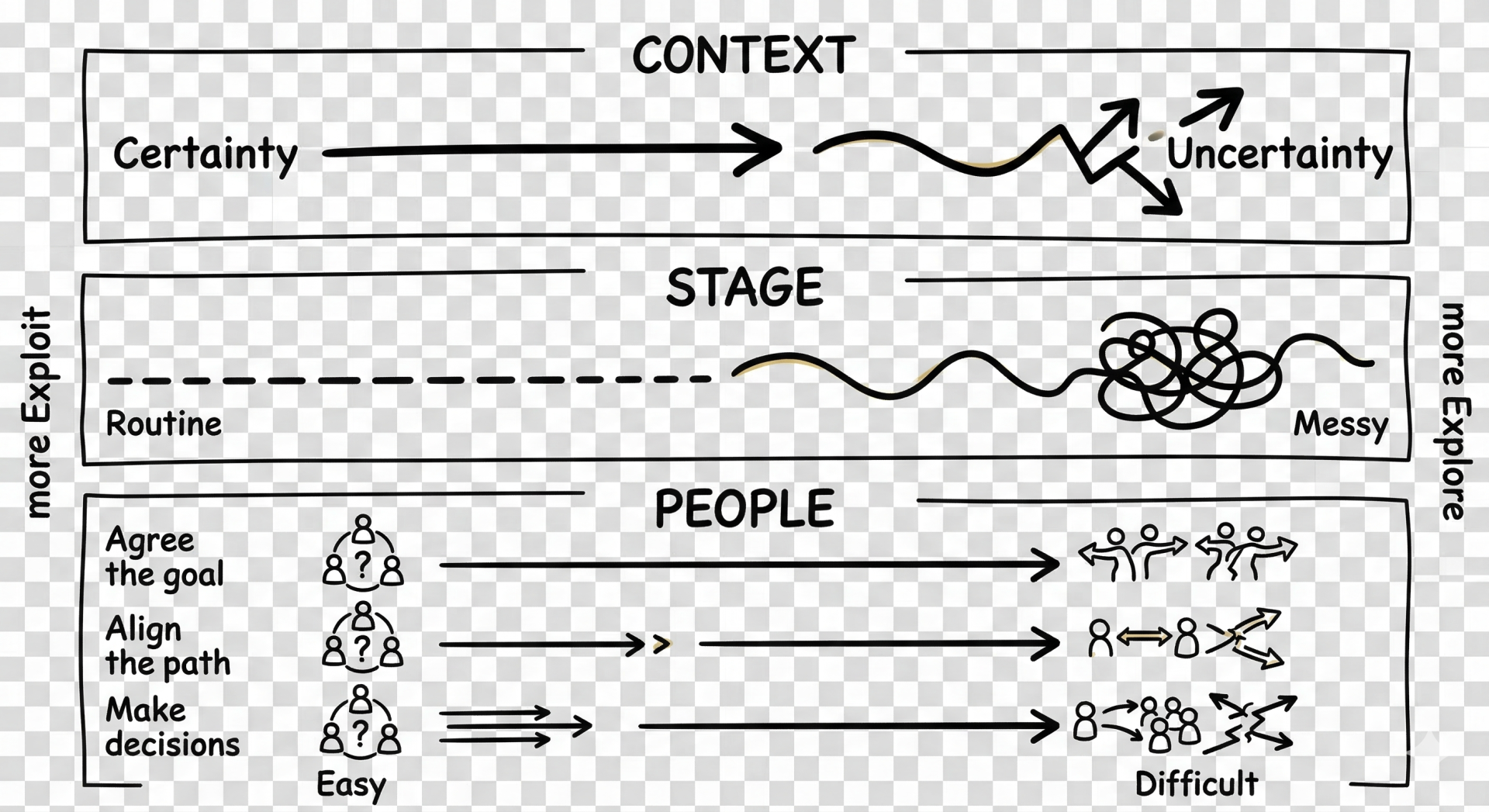
Some mess comes from context, some from stage, some from people
CONTEXT
Sometimes the mess is in the environment.
Markets change.
Constraints shift.
Information arrives unevenly.
What looked sensible a month ago stops fitting the reality in front of you.
STAGE
Sometimes the mess comes from the stage you are in.
Early work is often ambiguous.
Turnarounds are unstable.
Growth stretches the system.
Transitions expose what the old setup can no longer carry.
PEOPLE
Sometimes the mess comes from people and coordination.
Different functions see risks differently.
Incentives pull in different directions.
Trust is uneven.
Even good people can create friction when the work cuts across boundaries.
Often, more than one type of mess is present at once.
That is why the situation can feel hard to explain even when it feels obvious to live inside.
What kind of messy are you actually in?
If the work feels heavier than it should, the first question is not “Who is failing?”
It is: “What kind of messy are we actually dealing with?”
The better you name the source of the mess, the less likely you are to solve the wrong problem.
THE BIG PROBLEM: People are using stable-terrain reflexes in messy terrain.
And that is exactly where strong performers, executive teams, and succession pipelines start to wobble.
Quick self-audit: “Is the mess beating us?”
Messy terrain has patterns. It leaves clues.
If these symptoms keep showing up, the issue may not be effort or intelligence.
It may be that the operating style no longer fits the terrain.
Check anything that feels true.
Any one of these may be important enough to warrant a call.
Read it as “I” (you) or “we” (your team).
Do you have any of these symptoms...
Progress gets harder to read
☐ The work is happening, but it is harder to tell whether things are truly improving ☐ Progress feels less visible than it used to ☐ Teams are active, but movement feels uneven ☐ What looks busy does not always feel clearly forward
Decisions carry wider consequences
☐ Wins in one area create friction somewhere else ☐ Trade-offs stop staying inside one function ☐ Small choices create bigger ripples than expected ☐ The “right” move depends more on context and timing
The hard calls keep flowing upward
☐ Strong people are working hard, but the trickiest calls still escalate ☐ One person keeps ending up as the final integrator ☐ Alignment breaks down when priorities collide ☐ Confidence is strong in execution, but weaker in live cross-business judgment
This is not solved by more effort or more theory
When the terrain gets messier, the instinct is usually to push harder, add more planning, or reach for more frameworks.
Sometimes that helps a little. But it does not solve the deeper issue if the operating reflexes still assume a cleaner world than the one you are in.
That is why smart teams can keep working hard and still feel stuck.
They are not necessarily underperforming.
They may be using the wrong kind of logic for the kind of terrain they are in.
The question is no longer just “Do we have a plan?”
It becomes: “Do we have a way to make good calls while the situation is still moving?”
When the terrain won’t hold still, normal planning starts to break
Once the terrain becomes messy, the problem is no longer just “How do we execute the plan?”
It becomes: “What do we do when the plan itself cannot stay reliable for long enough?”
That is where a different decision model becomes necessary.
END
Messy is not one thing
When the plan keeps breaking, it usually is not because people are lazy, careless, or uncommitted.
It is because more than one force is shaping the situation at once.
What feels chaotic from the inside is often a pile-up of these forces at the same time.
That is why messy can feel so hard to explain.
You are not dealing with one clean problem.
You are dealing with overlapping sources of difficulty.
Normal text.
This is not usually a motivation problem.
It is what happens when messy terrain meets habits built for clearer, steadier conditions.
What looks like hesitation, misalignment, or lack of strategy is often something more specific:
The situation has outgrown the old rhythm for making sense of it.
The more check boxes, checked, the more we need to talk!
This isn’t a grit problem.
It’s what happens when messy terrain meets a weak decision rhythm.
That’s what being strategic actually is.
Normal text.
DEFINE: Being Strategic - the behaviour under uncertainty
Stop guessing what "being strategic" means
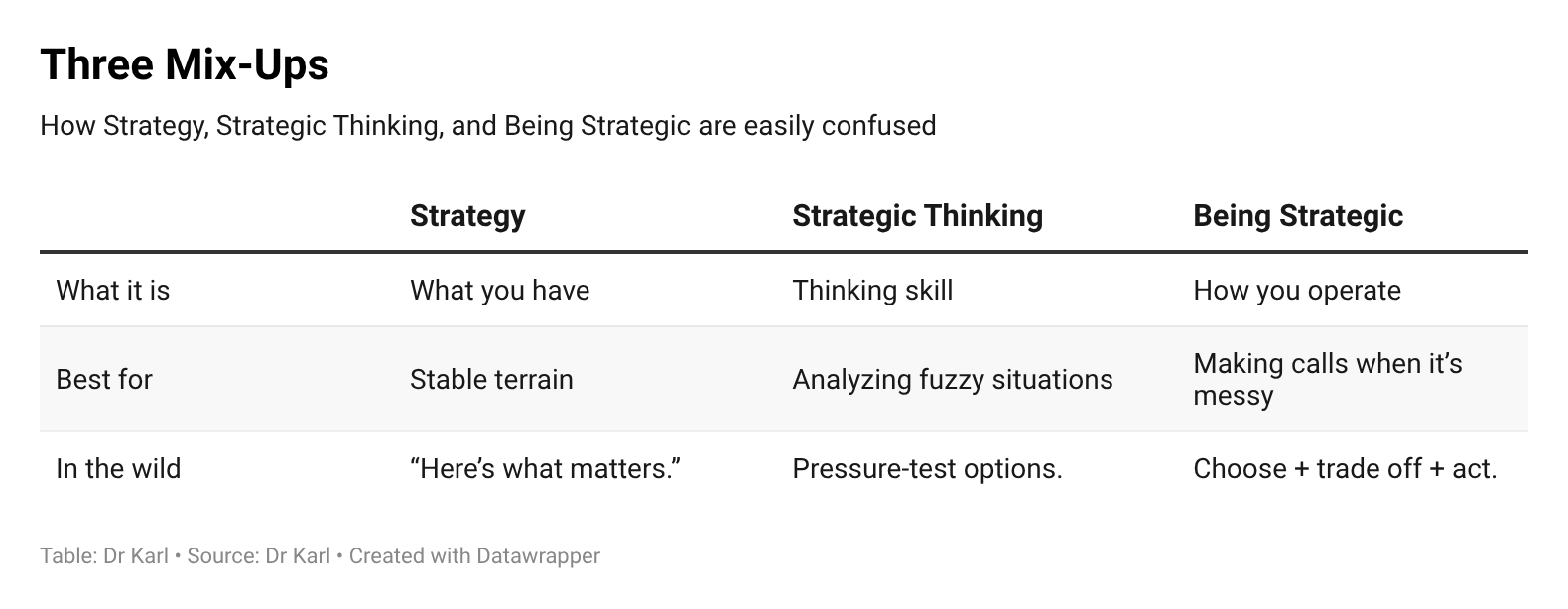
Most people hear that phrase and think of one of two things: a strategy document, or strategic thinking skills.
But in real work — executive meetings, promotions, interviews, messy weeks — what gets judged is simpler:
your behaviour under uncertainty.
Being Strategic is a behavior
Not a strategy document. Not “strategic thinking.”
Being strategic is building the plane mid-flight.
When clarity runs out, the decision still matters.
A behavior is a repeatable “when/then” move—visible in the room.
So we make “being strategic” behaviors concrete: triggers, boundaries, visible actions. By making “being strategic” concrete for you, you and they can improve.
Strategic When Messy is that upgrade—better defaults in the situations that decide outcomes.
Not another deck. Not another offsite. Not another theory.
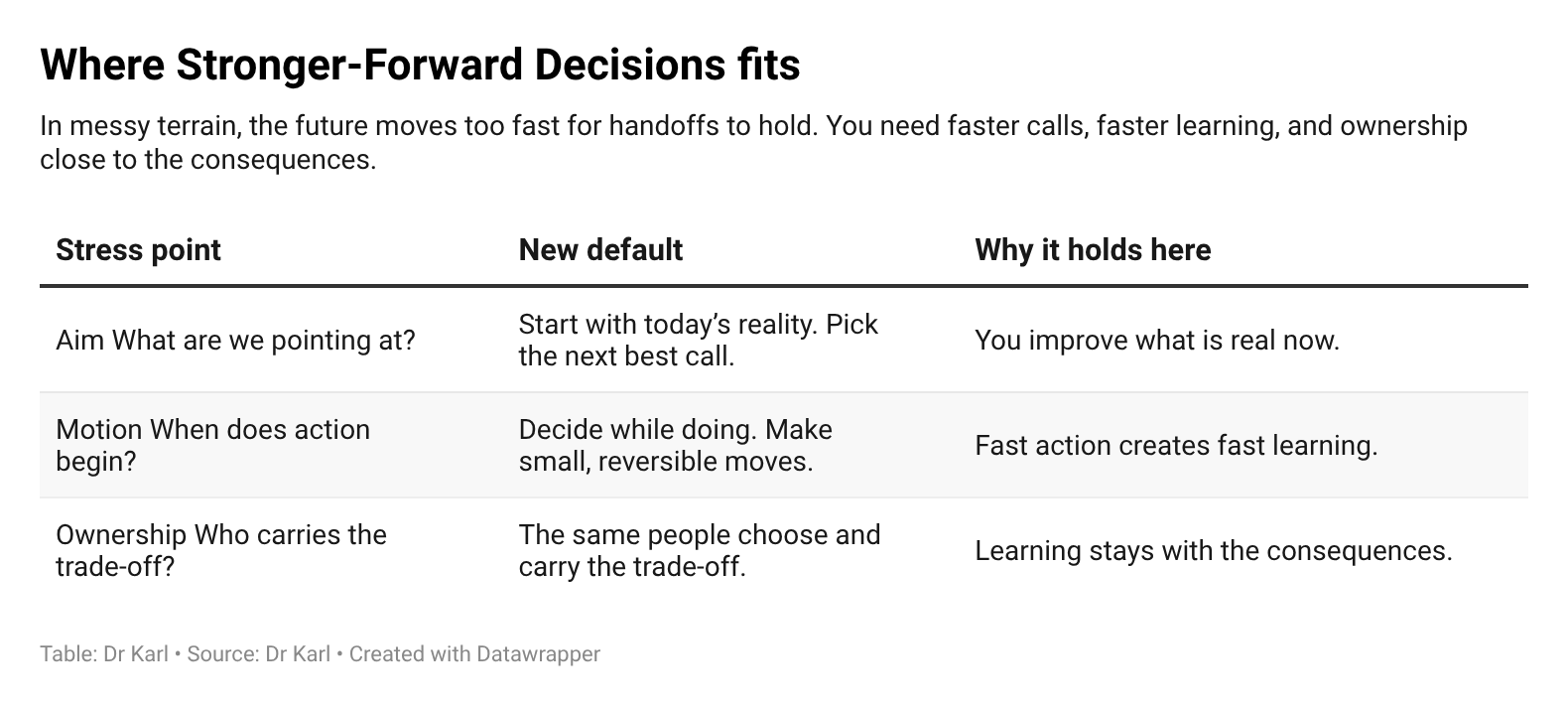
Stronger-Forward Decisions means: make clean calls, say the trade-off, run small tests, trace what changed.
The goal isn’t a strategy document. It’s to build Stronger-Forward Decisions when it’s messy.
What “Being Strategic” Actually Means
NOT the document:
Strategy = the choices you write down.
NOT just the skill:
Strategic thinking = the skill of reasoning to those choices.
This IS the point:
Being strategic = the habit of making calm trade-offs when the week gets noisy.
What to do when the plan won’t survive contact with reality
Most people default to a familiar move: pick a destination, write a plan, then try to execute it.
That works when things stay steady.
But when the situation keeps changing, you don’t need a smarter plan — you need a better decision habit.
We’ll figure out where the loop fits your current challenge.