A plan is strongest when the path is stable enough to be mapped ahead, broken into parts, and delegated with confidence.
That is not a flaw.
That is exactly what planning is for.
But when the terrain keeps shifting, clarity does not come from locking the sequence earlier.
It comes from making stronger decisions in the present — decisions that improve the position, reveal the next signal, and make the next move clearer than it was before.
Future-Back Planning tries to preserve a path. Stronger-Forward Decisions try to improve the position.
Where Future-Back Handoff Planning works
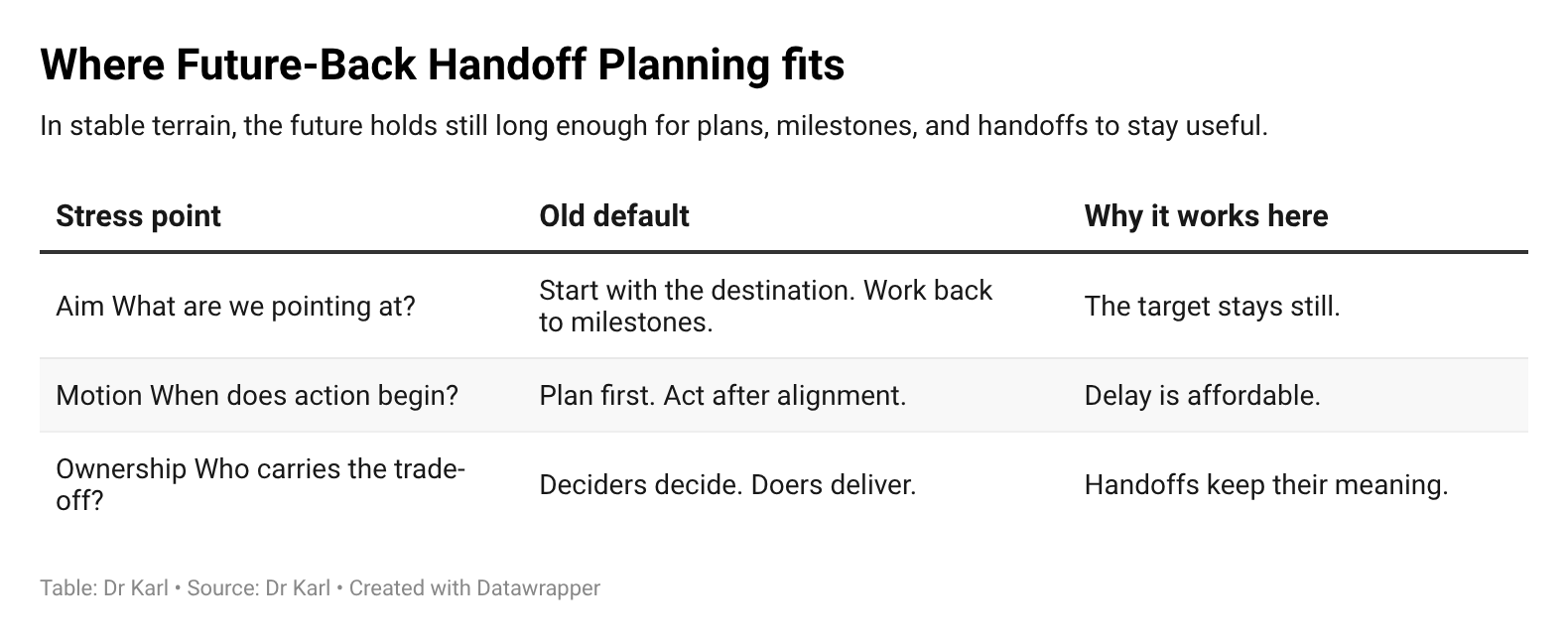
Future-Back Handoff Planning is useful when the terrain is stable enough for the sequence to stay trustworthy.
In these conditions, the path can be known early enough for slicing, sequencing, and handoff to work well.
Why it breaks in messy terrain
Future-Back logic starts to strain when the path cannot stay stable long enough for the early sequence to remain reliable.
The issue is not that people failed to plan carefully enough.
The issue is that the terrain moved faster than the plan could stay true.
When that happens, the handoff model weakens.
The people executing the work encounter reality that the earlier sequence could not fully anticipate.
Now the need is not just better compliance with the plan.
It is better judgement inside the moving conditions.
That is the moment where a different operating logic becomes necessary.
Where Stronger-Forward Decisions work
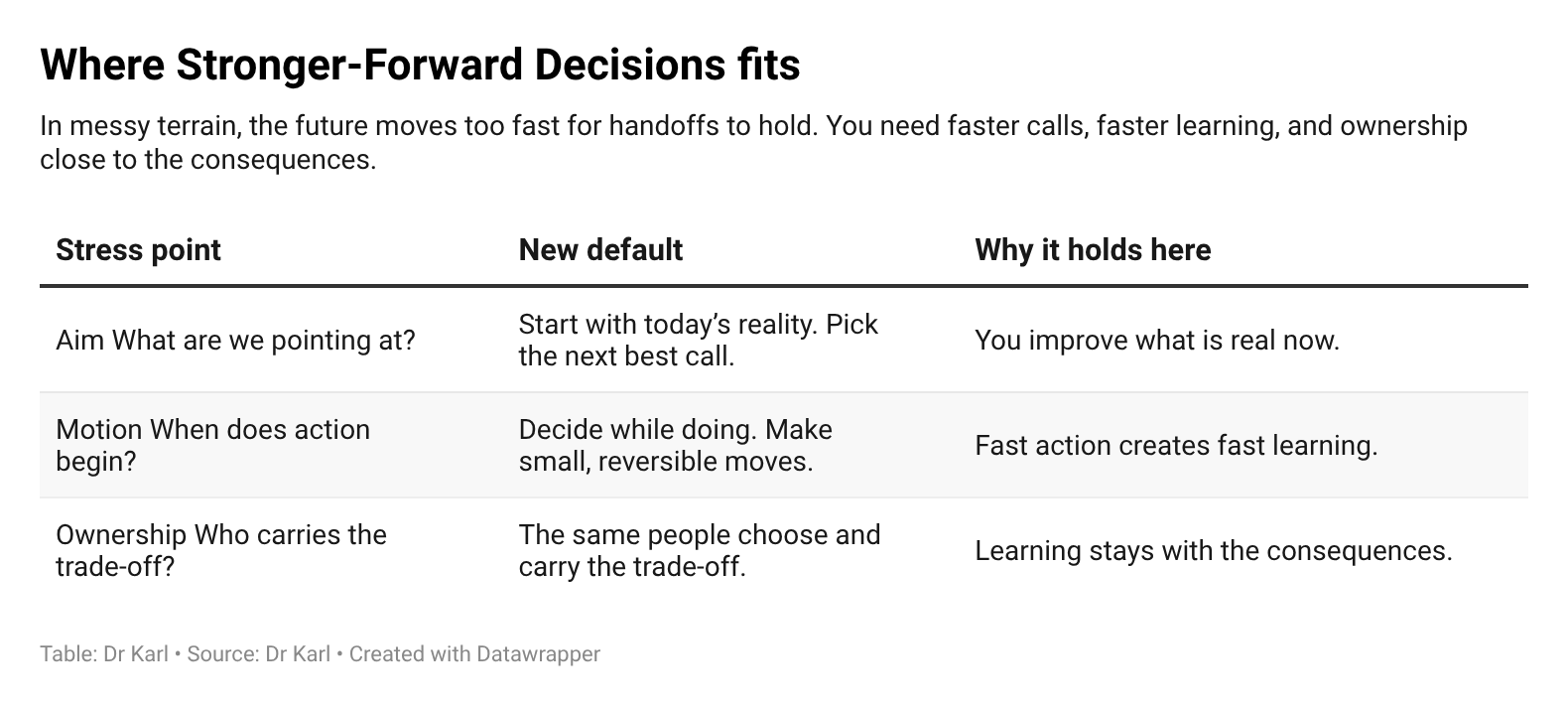
Stronger-Forward Decisions work when clarity has to be created while moving, not fully specified in advance.
In these conditions, progress comes less from preserving a pre-cut sequence and more from making good calls, learning quickly, and strengthening the next position.
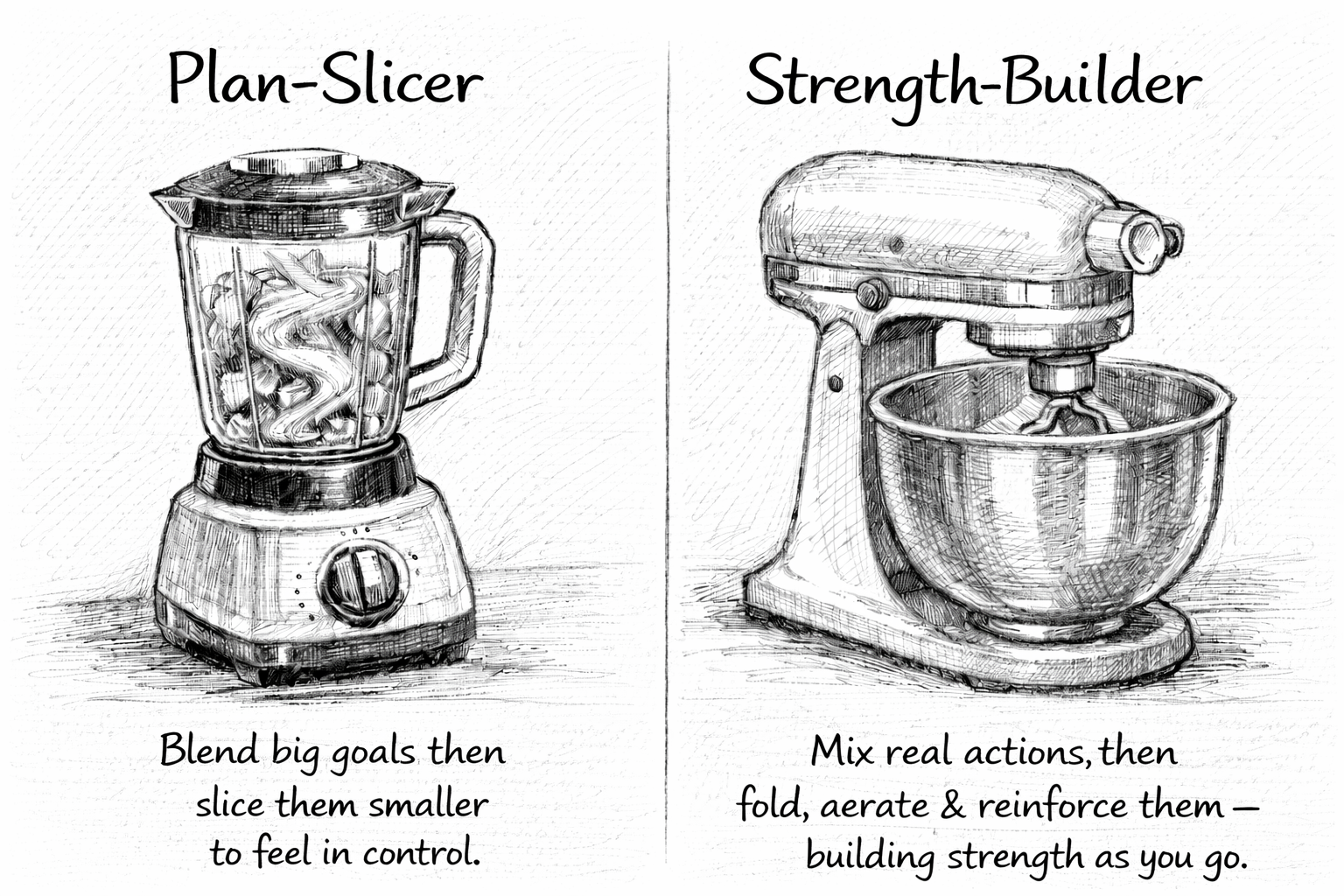
From plan-slicer to strength-builder
The difference is not just philosophical. It changes how the work gets handled.
Future-Back Planning blends the destination, then slices the work smaller.
Stronger-Forward Decisions mix real moves in real conditions — folding learning, judgement, and strength into the work as it unfolds.
Make the next best call. Learn while doing. Strengthen as you go.
Stronger-Forward does not mean making it up as you go.
It means treating the present as the best place to improve clarity — by making the strongest call you can now, seeing what reality reveals, and using that signal to improve the next move.
√Name the real tension — say what is actually in conflict instead of hiding it under vague language.
√ Make the next best call — choose with the information available, instead of waiting for impossible certainty.
√ Use reality as signal — let consequences teach you what the earlier model could not fully know.
√ Strengthen the position — leave the situation clearer, sturdier, or more informed than it was before.
The goal is not to predict far enough to remove uncertainty.
It is to behave in ways that make uncertainty more workable, decisions more grounded, and progress easier to see from here.
Knowing the move is one thing. Using it under pressure is another.
Seeing the difference between the two models is important.
But insight alone does not install better reflexes.
The harder part is using the stronger move when the pressure is real, the trade-off is live, and the room wants the easier default.
That is why the next two questions matter:
What gets in the way of better decisions under pressure?
And how do people actually build these behaviours until they become more natural?
See the Training
END
What works in stable terrain starts to fail in messy terrain
The old default is not wrong.
It is just built for a different kind of environment.
When the terrain gets messier, the reflexes that once made you successful often start to work against you.
In stable terrain
Clear lanes help.
Ownership is easier to define.
Handoffs are more predictable.
Plans survive longer.
Success is easier to measure within a function.
In messy terrain
Trade-offs cut across functions.
Ownership gets blurrier at the edges.
Timing and context keep shifting.
Plans need live adjustment.
Consequences spread further and show up later.
This is why more effort alone does not solve the problem.
What looks like hesitation, misalignment, or weak strategy is often something more specific:
THE BIG PROBLEM: People are using stable-terrain reflexes in messy terrain.
And that is exactly where strong performers, executive teams, and succession pipelines start to wobble.
Normal text.
DEFINE: Being Strategic - the behaviour under uncertainty
Stop guessing what "being strategic" means
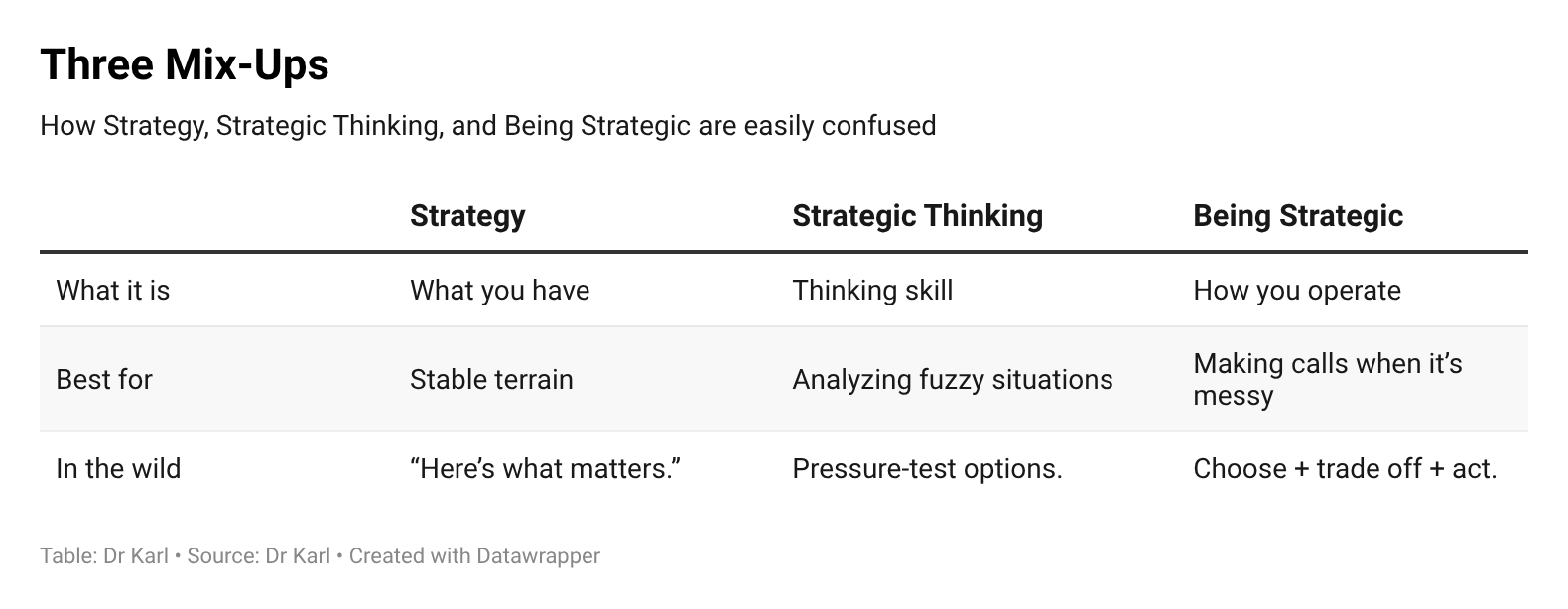
Most people hear that phrase and think of one of two things: a strategy document, or strategic thinking skills.
But in real work — executive meetings, promotions, interviews, messy weeks — what gets judged is simpler:
your behaviour under uncertainty.
Being Strategic is a behavior
Not a strategy document. Not “strategic thinking.”
Being strategic is building the plane mid-flight.
When clarity runs out, the decision still matters.
A behavior is a repeatable “when/then” move—visible in the room.
So we make “being strategic” behaviors concrete: triggers, boundaries, visible actions. By making “being strategic” concrete for you, you and they can improve.
Strategic When Messy is that upgrade—better defaults in the situations that decide outcomes.
Not another deck. Not another offsite. Not another theory.
Stronger-Forward Decisions means: make clean calls, say the trade-off, run small tests, trace what changed.
The goal isn’t a strategy document. It’s to build Stronger-Forward Decisions when it’s messy.
What “Being Strategic” Actually Means
NOT the document:
Strategy = the choices you write down.
NOT just the skill:
Strategic thinking = the skill of reasoning to those choices.
This IS the point:
Being strategic = the habit of making calm trade-offs when the week gets noisy.
What to do when the plan won’t survive contact with reality
Most people default to a familiar move: pick a destination, write a plan, then try to execute it.
That works when things stay steady.
But when the situation keeps changing, you don’t need a smarter plan — you need a better decision habit.
We’ll figure out where the loop fits your current challenge.